
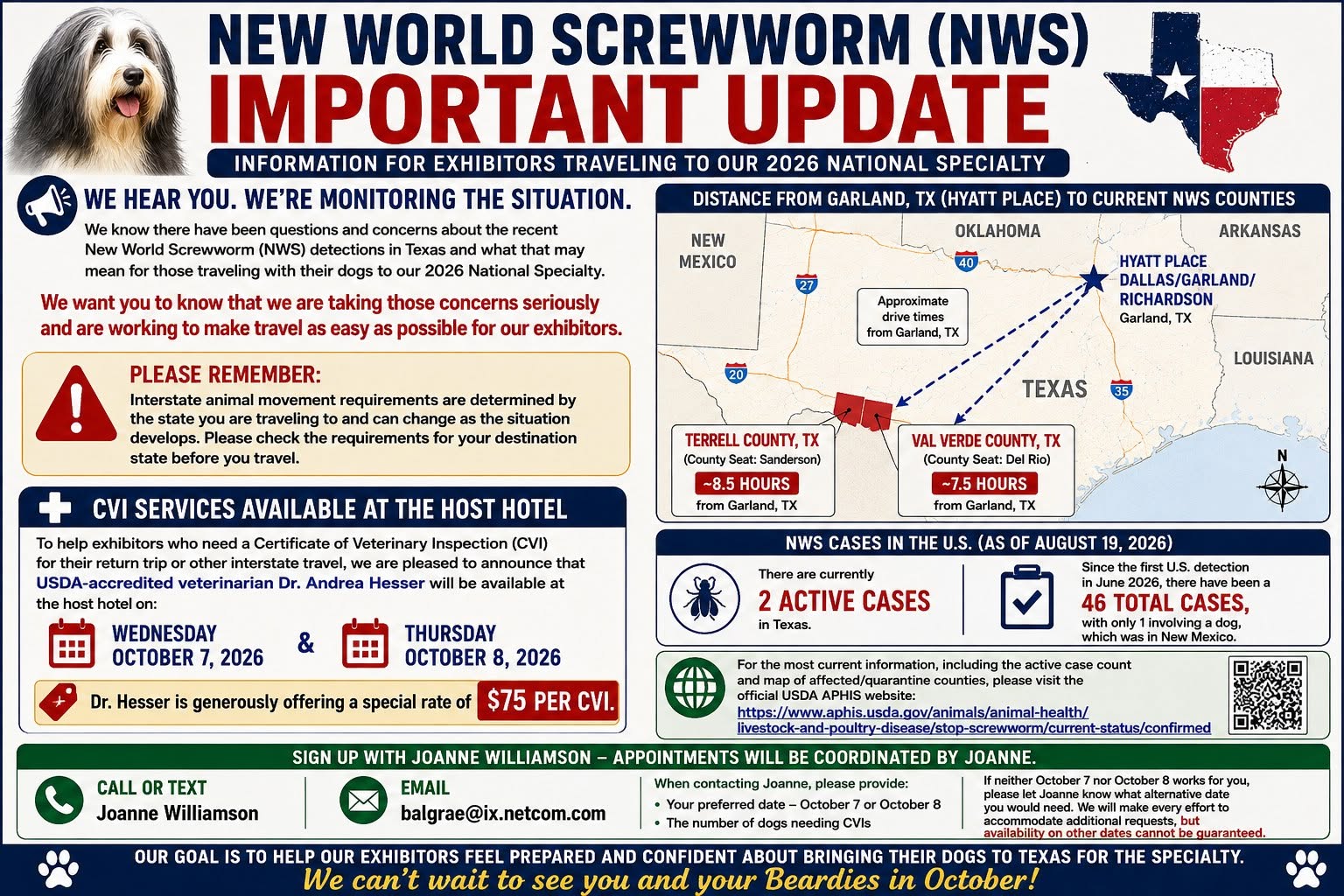
Before you travel, be sure to check the APHIS website for your state’s requirements for animals traveling to and from Texas. Each state has different requirements. The APHIS website also contains all the latest information about NWS cases, locations, and recommendations.
The AKC website also contains information about individual state requirements.
In the context of animal transport, an OCVI (Official Certificate of Veterinary Inspection) and a CVI (Certificate of Veterinary Inspection) refer to the exact same document — commonly known as a pet health certificate. The word “Official” is added to designate that the form meets specific state, tribal, or federal guidelines and is completed by a USDA-accredited veterinarian to satisfy legal transport and disease traceability rules.
Note for Agility and FastCAT Competitors
You do NOT currently need the special Texas NWS Treatment/Movement Certificate to leave McKinney, because McKinney is outside the infested zones.
You DO still need your state OCVI, because most states requirement applies to animals coming from Texas—not just animals coming from the Texas quarantine zones.
NWS OCVI Testing at the Specialty
We are offering OCVI testing at the Specialty on Wednesday and Thursday, October 7 and 8. If there’s enough interest, we can add testing on Saturday, October 10. Dr. Hesser, our USDA-accredited on-site vet, can test and certify your dogs for travel. Test cost is $75. To make an appointment, contact Joanne.
NOTE: There are many other vets in the area around Garland if you need a different appointment time for your travel schedule.
Dr. Hesser can also perform the following for you at the Specialty:
- Thyroid tests ($170) — sent to Michigan State
- Semen evaluation ($115) and freezing ($425)
- Brucellosis testing for semen freezing ($97, unless you have proof of test within the last 6 months)
- Titers (Distemper, Parvo, Adenovirus — $130)
Read more about Dr. Hesser here.
Preventing Screwworm Infestation
According to USDA, dog owners should take the following steps to help prevent the spread of NWS:
- Watch for signs of NWS, including irritated behavior, head shaking, smell of decay, and presence of fly larvae (maggots) in wounds. Seek immediate veterinary intervention if you suspect your dog is experiencing an NWS infestation.
- Treat the umbilical cords of newborn animals, and all wounds immediately, with an approved insecticide.
- Protect dogs from other wound-causing parasites like ticks. Oral and topical flea and tick preventatives containing afoxolaner, lotilaner, or sarolaner actively prevent and treat NWS larval infestations in pets.
You must be logged in to post a comment.